
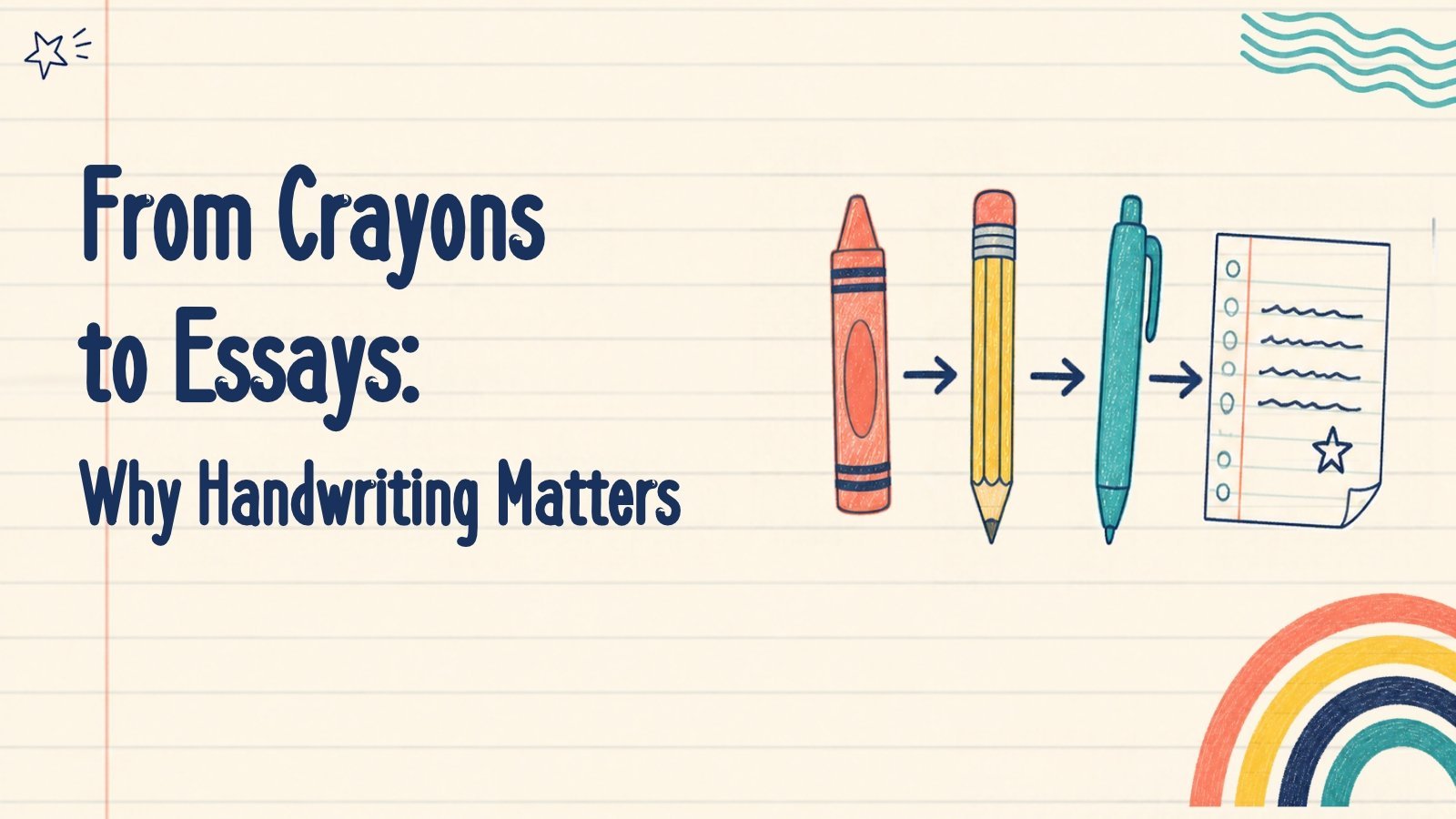
From Crayons to Essays: Why Early Handwriting Skills Shape Middle School Success
In today’s tech-driven world, it’s not unusual to see a toddler confidently navigating a tablet before they can properly hold a crayon. With keyboards and voice-to-text becoming our main ways to communicate, it’s tempting to view handwriting as a quaint, outdated skill, a relic of the pre-digital classroom.
But neuroscientists, occupational therapists and educators are raising a collective hand to say: not so fast.
Handwriting is far more than putting ink on paper. Early handwriting is a foundational learning exercise for young children. And the mastery of those clumsy first letters in kindergarten has a direct impact on a student’s ability to write complex, expressive essays in middle school.
Here is why the humble pencil is still one of the most powerful learning tools we have.
The Brain-Pen Connection in Early Childhood
When a young child learns to write, they aren’t just learning to make marks. They are shaping how their brain processes letters.
Unlike typing, which requires the same simple push of a button for every letter, handwriting requires fine motor skills and hand-eye coordination. A child must hold the pencil with the right pressure, judge spatial awareness (how big should this “A” be?), and make specific strokes in a specific order.
In one brain-imaging study, five-year-olds practiced letters by printing them, typing them or tracing them. Afterward, a network of brain regions linked to reading became active when the children looked at letters, but only after they had printed those letters by hand, not after typing or tracing them (James & Engelhardt, 2012). This suggests that forming letters by hand helps build letter recognition, one of the building blocks of early reading. In short, handwriting helps children learn to read, and reading helps them learn to write.
The Magic of “Automaticity”
To understand why a 6-year-old’s penmanship matters to a 13-year-old’s English grade, we have to talk about a concept called automaticity: doing a skill so smoothly that it no longer needs conscious attention.
Think about driving a car. When you first learn, it takes all your concentration just to steer, brake and check your mirrors. You can’t listen to the radio or hold a conversation. But once driving becomes automatic, you can easily chat with your passenger while navigating traffic.
Writing works the same way. It relies on a limited mental resource called working memory, the brain’s short-term “workspace” for holding and using information.
When a young child is writing, their working memory is almost entirely used up by the mechanics: How do I hold this pencil? Which way does the “d” face? Is there a space between these words? When handwriting skills are practiced and mastered, letter formation becomes automatic. The brain no longer has to think about how to write the word, so it can focus on what to write. In fact, researchers have found that how fluently young students handwrite predicts how much and how well they write (Graham et al., 1997).
The Middle School Squeeze: When Writing Becomes Expression
Fast forward to middle school. Students are no longer “learning to write”; they are “writing to learn.” They are asked to analyze historical events, argue persuasive points and craft creative narratives.
This is where early mastery of handwriting, or the lack of it, shows its true colors.
1. The Bottleneck Effect: If a middle schooler has not reached handwriting automaticity, the physical act of writing remains a mental burden. Because their brain is still partly focused on letter formation and legibility, they have less working memory left for higher-level tasks like generating ideas, choosing words and building sentences. Their best thoughts get stuck in a “bottleneck” between their brain and their pen.
2. Shorter, Simpler Sentences: Students who struggle with handwriting fluency tend to write less and produce weaker compositions. The good news: a large review of handwriting studies found that teaching handwriting improved not only legibility and speed, but also the length and quality of students’ writing (Santangelo & Graham, 2016). A student might know a fantastic, complex word, but if it’s hard to spell and write out by hand, they may swap it for a shorter, simpler word just to get it down.
3. The Frustration Factor: When writing by hand is tiring or uncomfortable, motivation drops. Middle schoolers with handwriting difficulties often come to dislike writing assignments, seeing them as exhausting chores rather than chances for self-expression.
Striking a Balance in the Digital Age
None of this means we should banish keyboards from the classroom. Typing is an essential life skill. However, typing should supplement, not replace, early handwriting instruction.
Keyboarding lets middle and high schoolers edit easily and type at the speed of thought, which is great for later drafting. But the foundation of language, memory and organized thinking is built with a pencil in hand during those early years.
Try This: What Can Parents and Educators Do?
- Pair fine motor play with real letter practice. Playdough, threading beads and using tweezers build hand strength and are great warm-ups. On their own, though, motor activities have not been shown to improve handwriting; direct handwriting instruction has (Santangelo & Graham, 2016). So follow play with a few minutes of letter practice.
- Prioritize explicit instruction. Handwriting shouldn’t be busywork. It works best with short, focused lessons on grip and letter formation in early elementary school, and instruction tailored to a child’s needs is especially helpful (Santangelo & Graham, 2016).
- Praise the process, not just the neatness. Focus on effort and fluency rather than perfection. The goal is automaticity, not calligraphy.
- Keep the keyboard in its place. Introduce typing as children grow, while still giving younger learners regular chances to write by hand.
Ultimately, the goal of writing is to share our deepest, most complex thoughts with the world. By helping children build fluent handwriting in their early years, we aren’t just teaching them how to make letters on a page. We are giving them the mental freedom to find and share their unique voice.
Kiddie’s takeaway: Fluent handwriting frees young minds to focus on ideas, so a few minutes of letter practice today supports stronger writers tomorrow.
Looking for more simple ideas to support learning at home? Browse our Parents and Families posts.
References
Graham, S., Berninger, V. W., Abbott, R. D., Abbott, S. P., & Whitaker, D. (1997). Role of mechanics in composing of elementary school students: A new methodological approach. Journal of Educational Psychology, 89(1), 170–182. https://doi.org/10.1037/0022-0663.89.1.170
James, K. H., & Engelhardt, L. (2012). The effects of handwriting experience on functional brain development in pre-literate children. Trends in Neuroscience and Education, 1(1), 32–42. https://doi.org/10.1016/j.tine.2012.08.001
Santangelo, T., & Graham, S. (2016). A comprehensive meta-analysis of handwriting instruction. Educational Psychology Review, 28(2), 225–265. https://doi.org/10.1007/s10648-015-9335-1
About the Author
The Kiddie Scholar is created by a licensed psychologist with a background in clinical, counseling, and school psychology. Each week, Brain Explained breaks down research on how different brains learn into practical ideas for parents and educators.
Disclaimer
This post is for general educational purposes only. It is not a diagnosis, treatment, or individual advice. If you have concerns about a child’s learning, development, or wellbeing, please talk with a qualified professional, such as the child’s doctor, school psychologist, or another licensed specialist.
